
High Tech Gays: Subverting Discriminatory Systems
High Tech Gays, an LGBTQ social and activist organization that operated in Silicon Valley between 1983 and 1997, advocated for inclusion in the tech space for people beyond the binary. The group worked hard to achieve protections for the civil rights of LGBTQ workers, building their collective through a dedicated website and discreetly emailed monthly newsletters that went to over a thousand people. The collective lobbied tech companies to include sexual orientation in their internal equal opportunity policies, and slowly paved the way for meaningful legislation in support of inclusion at the state and federal levels.
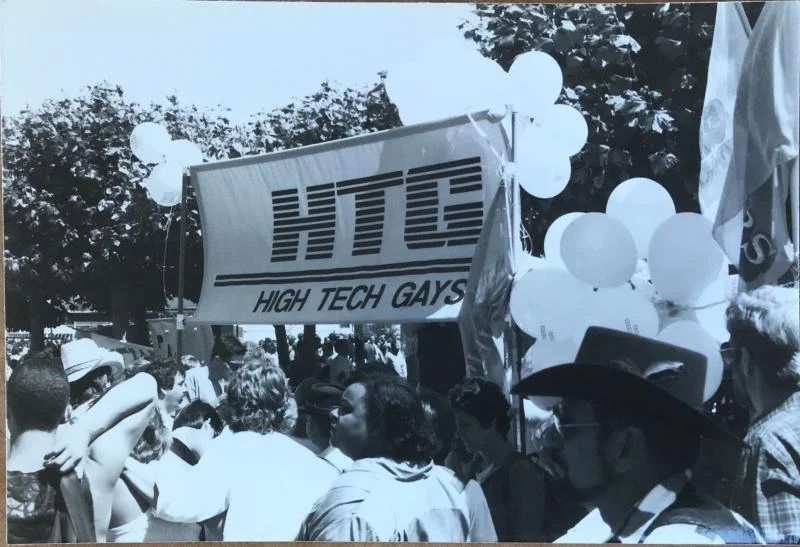
Source: High Tech Gays.
The beginnings
In January 1983, ten people met in San Francisco under the name of “Lesbian and Gay Associated Engineers and Scientist” or LGAES. Of these, three of them, Denny Carroll, Rick Rudy, and Eric Lipanovich, continued to meet through January and February that year, to discuss the founding of a South Bay chapter of LGAES. This eventually culminated in the first official chapter meeting on March 15, 1983, and this chapter named itself “High Tech Gays.”
In 1985, LGAES in San Francisco stopped operations, and High Tech Gays became an independent organisation, and welcomed members of LGAES into their fold. The collective focused on the unique needs of LGBTQ people in the high-tech business sector in Santa Clara Valley. Their political motivations of advocating for the rights of LGBTQ people aside, they also created space for social events and excursions to museums, theatres, snow slopes, and campsites. They brought the community together at potluck dinners and featured keynote speeches from local mayors, supervisors, police and fire chiefs, national leaders, political candidates, state assembly members, judges, CEOs, and BAYMEC.
All of this was happening at a time when the political scenario in California involved Propositions 6 and 64, which sought to remove gay teachers from classrooms and quarantining people with AIDS altogether. The AIDS crisis was also making life challenging for the LGBTQ community. People were forced to come out to their immediate circles, either out of necessity or to humanize themselves while advocating for their rights. They had to navigate life while coping with the lack of safety in their worlds of work, facing a very real prospect of losing their homes, families, and work because of their identities. Many hid their full identities, out of fear of retribution and reprisals, and of losing promotions, especially in high-tech government jobs requiring security clearances.
Mobilizing for change at scale
In 1983, High Tech Gays sued the Defense Industrial Security Clearance Office (DISCO) for subjecting gay and lesbian employees to more intense scrutiny and investigation for secret and top secret clearances, all because of their sexual orientation. They won the case in 1990, shifting the approach to LGBTQ people within the workplace, building in safeguards to protect their interests and safety in the workplace, and facilitating the humanisation of the community at a time when the AIDS crisis normalised deeply entrenched forms of othering.
High Tech Gays not only facilitated awareness, but also created more possibilities for civil society to mobilise. More and more social groups were established, both official and unofficial, to advocate for the rights of LGBTQ people at the workplace.
Groups like Friends of Dorothy and the Gay and Lesbian Employee Network came up, expanding across the reach of Silicon Valley, within corporations like Hewlett Packard, Sun Microsystems, and Oracle. Many of these groups came about as communities for solidarity and connection, and slowly built out membership directories and discreet newsletters that also culminated in knowledge creation on internal business practices across the length and breadth of the high tech sector. This knowledge repository helped secure protections in the workplace, which was particularly significant in the absence of state or federal protections for the community. This is not to mean that all of Silicon Valley jumped up to build inclusive policies – there were conservative companies as well that took much longer to prioritize inclusion and adopt similar policies.
For instance, Bennet Marks, a former software manager at Apple, was inspired by HTG and his experience on the AIDS Response Committee at Apple, began to work directly with the company to develop an inclusive staff policy. This led to the creation of Apple Lambda in August 1986, which built Apple’s non-discrimination policies and inspired other companies to follow suit, as well. Inspired by Bennet’s activism, his partner Kim Harris, a manager at Hewlett Packard, set up an unofficial employee group for LGBTQ folks within the organisation. However, Hewlett Packard was hesitant to offer any of its company resources toward such mobilisation, and Kim took matters into his own hands, parsing out company health plans, and calling out the company for the refusal of AIDS treatment for former staff. This kicked things in motion at Hewlett Packard. At first, there was unanimous refusal from the company’s leadership. Kim used the opportunity to create awareness through theatre performances that featured employees’ stories, into action. A whole year later, a unanimous yes emerged from the leadership team and non-discrimination and diversity education policies were adopted company-wide.
High Tech Gays played a significant role in expanding networks of communication across corporate initiatives, thus helping spread word on increased protections and greater inclusion of LGBTQ people within company walls and beyond, into national politics. The emergence of internal company policies paved the way for state and federal laws. For instance, in September 1992, California adopted protections against non-discrimination on the grounds of sexual orientation into the state’s Labor Code. By 1993, eight Fortune 500 companies offered benefits for domestic partners. By 2001, it crossed 100. With time, more and more companies stepped up to adopt these policies.
Sowing seeds of subversion
High Tech Gays were fundamentally subversive, both within the corporate set up and beyond. One of the major shifts they produced came from their open challenge to the “security risk” mindset. The government's security clearance policies were reflective of a deeply embedded belief system that treated LGBTQ folks as inherently suspicious and dangerous. By directly suing the government and forcing courts to scrutinize this logic, High Tech Gays went for the intellectual and legal foundation that justified excluding LGBTQ people from entire sectors of employment. They also used the master’s tools to expand the surface area for subversion by subverting corporate power from within. They were not outsiders protesting at the gates, they were all engineers, programmers, and professionals who were within the tech industry's most powerful companies. They cleverly used their insider status and professional credentials to make a business case for inclusion, thus effectively turning capitalism's own logic against discriminatory practices. They systematically contacted over 100 Silicon Valley companies in the course of their advocacy, effectively co-opting corporate communication channels to spread counter-hegemonic values.
High Tech Gays also rejected invisibility as a survival strategy. In the 1980s, many LGBTQ people in conservative professional environments were forced to choose survival over living out their whole identities, which they did by leaning into invisibility, remaining closeted to keep their jobs. High Tech Gays subverted invisibility by creating visible, organized gay professional identity in spaces where this very identity was given no place, such as in the defence contracting, tech companies, suburban Silicon Valley hubs. They provided alternatives to bars and baths as meeting spaces, asserting that LGBTQ identity belonged in professional and civic contexts, and not just in marginalized nightlife spaces. In doing this, they normalized what was considered “deviant” and reclaimed pubic and professional spaces, and made discrimination (previously the default) into something that needed justification, while inclusion was baked into corporate policy.
