
Mir (Мир)
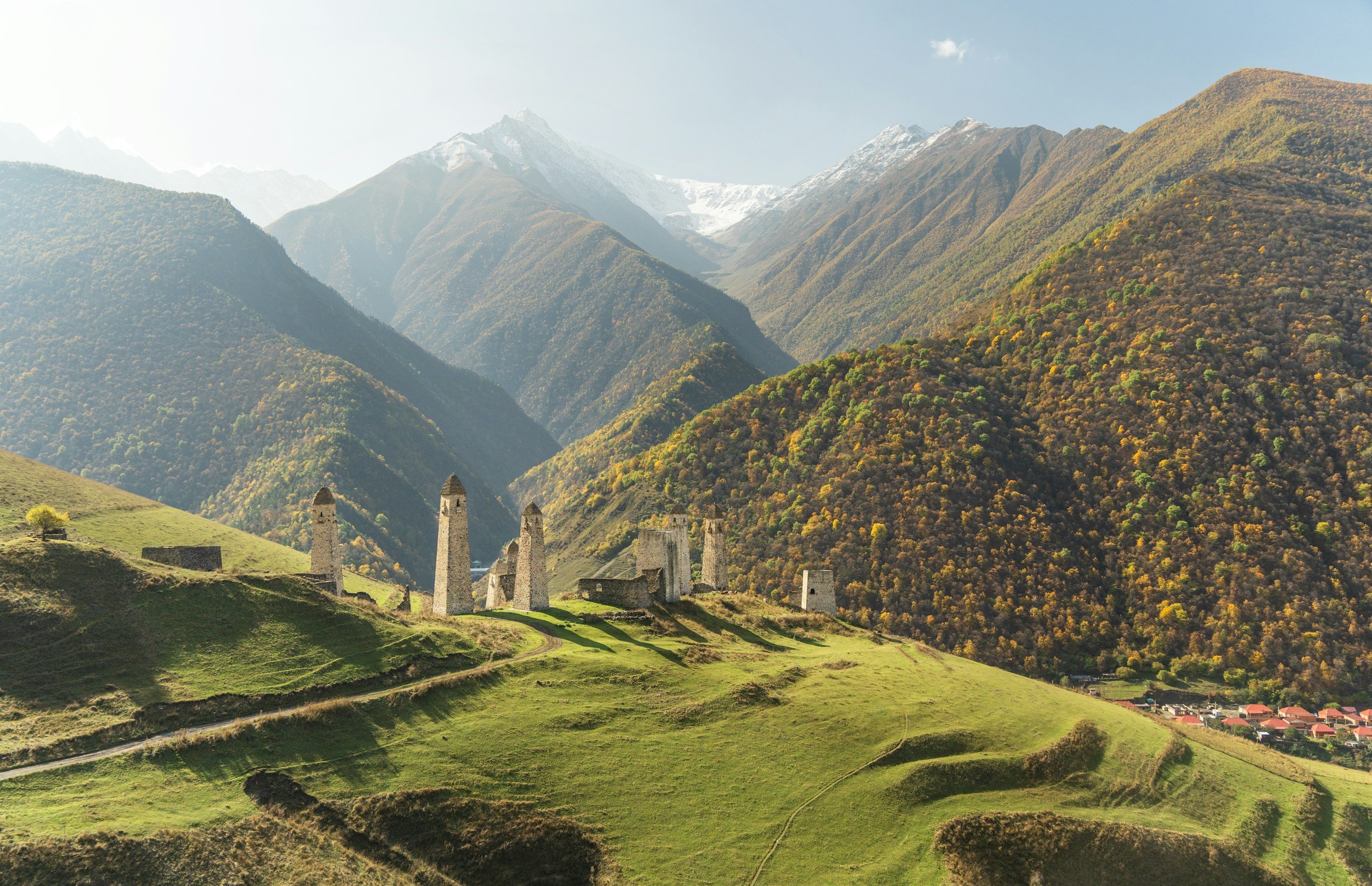
Nature’s resources are meant for communities of human and non-human beings. The appropriation of these resources for the use of a few arrives at the cost of many, as they are not only deprived of these resources, but are also forced to give up on their kinship and relationship with nature. This deprivation creates a major imbalance that disrupts life and livelihood, and is rather an action by design, orchestrated by colonial and capitalist forces.
Mir, the Russian / Slavic concept of collective economics and ownership offers us a pathway to move away from exploitative, extractive, and appropriating forces.
Before proceeding, we want to state that Mir is a historical institution of the Russian and broader Slavic peasantry rather than a living community practice in the way that many other entries in this archive are. The Mir as a functioning governance institution was effectively destroyed first by the Stolypin reforms of 1906–1911, which deliberately dismantled communal land tenure in favour of individual peasant proprietorship, and then decisively by Soviet collectivization beginning in 1929, which abolished the Mir's self-governing functions and forced its members into state-controlled collective farms. We draw on the Mir as a historical model and a source of governance principles rather than as a living practice whose contemporary custodians we can name and defer to, and we acknowledge that this changes the nature of our accountability in relation to it. We also acknowledge that Mir was not exclusively Russian. Related communal institutions existed across Slavic and Eastern European societies, such as the Zadruga in South Slavic communities, the Toloka in Ukraine, the Gromada in Poland, and the broader principle of communal land governance it represents belongs to no single national tradition. We welcome engagement from historians, community scholars, and descendants of peasant communal traditions across the Slavic world who can deepen and correct our account.
Understanding Mir
The word mir, in Russian, carries two meanings, namely “peace” and “world.” Both are present in the institution to which the term refers. The mir, also called the obshchina, refers to a commune comprising the self-governing community of peasant households that managed the political and economic affairs of the peasantry in villages across most of Russia for centuries. As part of its governance responsibilities, the mir stewarded local forests, fisheries, hunting grounds, and vacant lands. It elected its officials, who were all heads of households chosen by the peasant assembly. It took on peasant labour and acted under the watchful eye of community opinion. The mir led only as long as it advanced the common interests of peasants. If they did not, those on the mir could be recalled.
Land belonged to the mir as a whole and could not be taken away or sold. Strips of land were redistributed periodically among households in order to reflect changing family needs, ensuring that no household accumulated more than its fair share. The mir handled dispute resolution, taxation, and communal order without requiring armed forces as expulsion from the commune was the ultimate sanction rather than militaristic violence. The mir practiced collective governance that managed real tensions and competing interests through community deliberation.
Within the mir, the peasant assembly, called the skhod, was the decision-making body. Decisions were never made unilaterally but required broad agreement. The mir operated according to the principles of reciprocity and collective responsibility rather than on individual accumulation.
What Mir unsettles in AI governance
The data, models, compute infrastructure, natural resources, and intellectual property through which AI systems are built are governed by a property regime that concentrates ownership in the hands of the powerful – often corporations and wealthy states. In reality, communities generate data, land is consumed for data centers, natural resources are exploited through the AI lifecycle, and minerals are mined to assemble the hardware essential for AI to work. None of these resources are inherently the property of the powerful and the wealthy – but they are the ones that make decisions on these resources, access these resources in unreasonably large quantities, and benefit most from their use. The resultant product is pushed onto people with the message of inevitability. The mir offers a different principle. It reminds us that resources, particularly those on which collective life depends, belong to the community as a whole, cannot be privately appropriated, and must be governed through communal deliberation for communal benefit.
The mir’s model of periodic redistribution is also valuable. The structural feature of the current AI economy is that the benefits and harms of AI development compound over time. However, the benefits of these technologies are privatized and the harms are socialized. The mir’s approach to periodic redistribution of land to reflect changing household needs is a powerful governance principle calling for the redistribution of benefits over time, rather than its accretion in the hands of the wealthy alone. This form of redistribution is not an afterthought or taxation. Rather, it is actual redistribution in real time as a structural feature of the governance system itself.
The mir was a site of genuine local self-governance, but existed within larger political structures, such as the first the tsarist state, followed by a more autonomous period before Soviet collectivization abolished it. The tension between local communal governance and external state or corporate authority characterizes AI governance today. Local communities develop norms, expectations, and governance practices around the technologies that affect them. These norms are routinely overridden by platform policies set in distant corporate headquarters. The mir’s experience, including its eventual destruction, is a warning about what happens when external authorities decide that local communal governance is inconvenient.
References
Evans, C. (2022). Notes on the Russian Peasant Commune. https://www.ctevans.net/Nvcc/HIS241/Notes/Commune.html
Millar, J. R. (2004). Encyclopedia of Russian history (Vol. 3). New York: Macmillan Reference USA.
Connections / Clio-online. From the commune to the ‘borderless world’: Russian conceptions of land and ownership. https://www.connections.clio-online.net/article/id/fda-133275
Pallot, J. (1999). Land reform in Russia, 1906-1917: peasant responses to Stolypin's project of rural transformation. Clarendon press.
