
Kolam
The advent of AI and its proliferation have been presented as an “inevitable” reality. This argument claims that AI is an unstoppable next step in technological evolution. It claims that once humans built basic computers, the creation of advanced code and machine learning are natural next steps that are inevitable. AI literacy is being pushed as absolutely essential, lest one falls back and gets “left behind.” This rhetoric serves those who profit from the AI lifecycle, because the push to use and apply AI, or build using AI, means that its uptake keeps profits going for those that are already powerful.
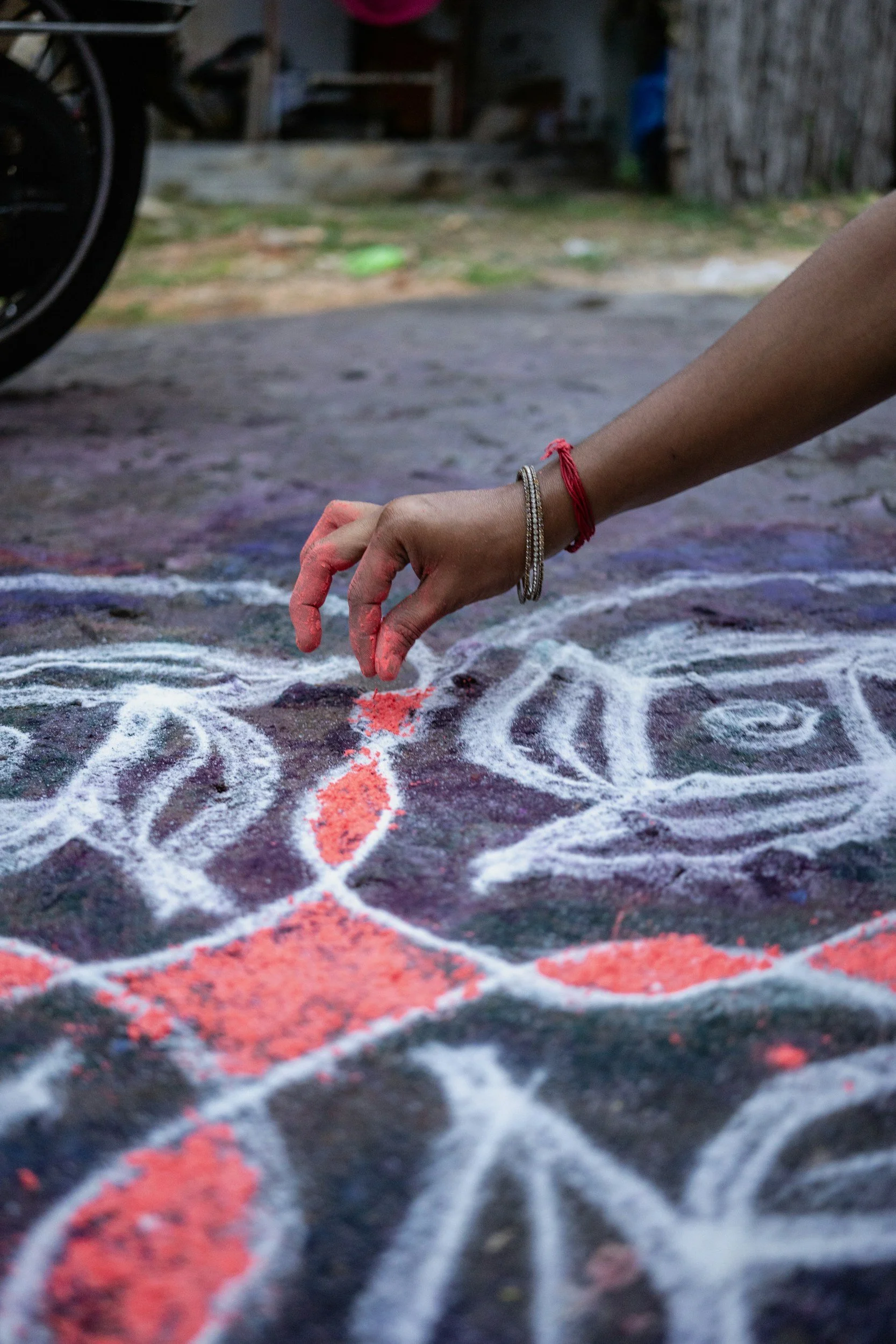
Offering a gentle counter to this is the practice of drawing kolam.
Before proceeding, we want to state that the practice of drawing kolam, is a living practice belonging to Tamil women and several communities across South India and South and Southeast Asia. It is not a single uniform tradition but a diverse family of practices varying across caste, region, and household. The knowledge of kolam is transmitted within families and communities through its women. We also want to name the fact that it is one of the areas that is deeply tied to the patriarchy as a form of emotional care labour performed by women, and that over time, the practice also gained casteist overtones with the influence of Brahminical customs. However, we draw from kolam as an ancient practice that dates back to the Sangam era. We welcome correction from those engaging with the concept.
Understanding Kolam
Every morning, across South India, Sri Lanka, Malaysia, Singapore, and everywhere that Tamil communities have carried out and do continue their traditions, women rise before sunrise to sweep the threshold of their homes and draw kolams. Using rice flour, chalk powder, or stone dust held between their fingers, women create intricate geometric patterns on ground. They do not use any measuring tools, and no sketches are prepared in advance. The design emerges through cell memory, and the knowledge is passed down generationally. A mathematical intelligence is cultivated over years of practice and observe-and-learn is a key process in the journey. By mid-morning, the Kolam is erased through footfall, scattered by the wind, and sometimes even nibbled at by little birds and ants. The next morning, the ritual endures. This cycle of making and unmaking is repeated every day across millions of thresholds, and is one of the oldest living traditions in the world.
Kolam is a Tamil word carrying multiple meanings simultaneously: beauty, form, play, disguise, and ritual design. The practice is rooted in the belief that householders carry a karmic obligation to feed and welcome all living beings. Rice flour is the traditional medium precisely because it feeds: birds, ants, insects, and small creatures consume the pattern through the day, so that the act of creating beauty is simultaneously an act of ecological generosity. It has also been described as a daily ritual of generosity that blesses the household and the greater community. The threshold where kolam is drawn is the liminal space between inside and outside, between the domestic and the street, between the human and what lies beyond it. To draw at the threshold is to govern that liminal space and to welcome what should enter and orient what should leave.
The mathematical sophistication of kolam is documented and particularly remarkable. Key mathematical skills are exercised in making a kolam. Pulli kolam, the dot-grid variety, requires the maker to keep count of vertices, loops, curves, and intersection points in her head, maintaining spatial reasoning across a complex structure without any external aid. Scholars have connected kolam patterns to Fibonacci series, algebraic and numeric principles, knot theory, and fractal geometry. Computer scientist P. Gerdes documented how kolam encodes mathematical principles that were independently discovered in formal mathematics centuries later. This mathematical knowledge was never housed in an institution, never written down in a textbook, and never recognized by the formal education system that dismissed it as a domestic ritual. It has lived and continues to live in women’s bodies, and is transmitted through practice.
What Kolam Unsettles in AI Governance
Kolam challenges AI governance’s understanding of what knowledge is and where it lives. The mathematical intelligence of kolam practitioners, which is sophisticated enough to engage knot theory, fractal geometry, and recursive pattern logic, has been produced and transmitted entirely outside the institutions that AI governance treats as the sources of legitimate expertise. It is not certified, published, or recognized. It is embodied, practiced, and alive. AI systems trained on institutional knowledge are systematically blind to this kind of knowledge. They cannot learn what has never been written. Governance frameworks that evaluate AI by what it knows through its training data inherit this blindness. Kolam asks us what vast intelligence we have excluded from the systems we are building, because it was held in women’s bodies at the threshold and never made its way into a document.
The transience of kolam is an equally important challenge. Kolam is made to be destroyed. Its beauty is inseparable from its impermanence. The act of remaking it each morning is not a failure to achieve permanence but is the practice itself. This is a direct philosophical challenge to AI governance’s orientation toward the permanent and the scalable: The model trained once and deployed everywhere, the regulation written to last, the dataset accumulated and archived. The kolam tradition suggests that certain forms of governance require daily renewal as a matter of integrity and not inefficiency. A governance practice that must be actively remade each day, in attentiveness to the current condition of the threshold, cannot drift from its purpose in the way that a regulation written once and applied indefinitely can.
Kolam also insists that governance is an embodied, ecological act. The rice flour feeds the birds and ants; the daily sweeping of the threshold is an act of care for the ground; the posture of drawing while bending or squatting close to the earth is a physical orientation of humility. AI governance processes are conducted in offices, on screens, in conference rooms that have no relationship to the ecological systems AI is reshaping. Kolam invites governance practitioners to return to the threshold: to the liminal space where technology actually meets life, where they are close enough to the ground to see what is happening there.
References
Gerdes, P. (1989). Reconstruction and extension of lost symmetries: examples from the Tamil of South India. Computers & Mathematics with Applications, 17(4-6), 791-813.
Nagarajan, V. (2019). Feeding a Thousand Souls: Women, Ritual, and Ecology in India: an Exploration of the Kōlam. New York: Oxford University Press.
Ramesh, S. H., & Rajabiyazdi, F. (2026). Pulli Kolam: A Traditional South Indian Craft Practice for Representing Data. arXiv preprint arXiv:2603.02343.
Bishop, A. (1991). Mathematical enculturation: A cultural perspective on mathematics education (Vol. 6). Springer Science & Business Media.
