
Potlatch
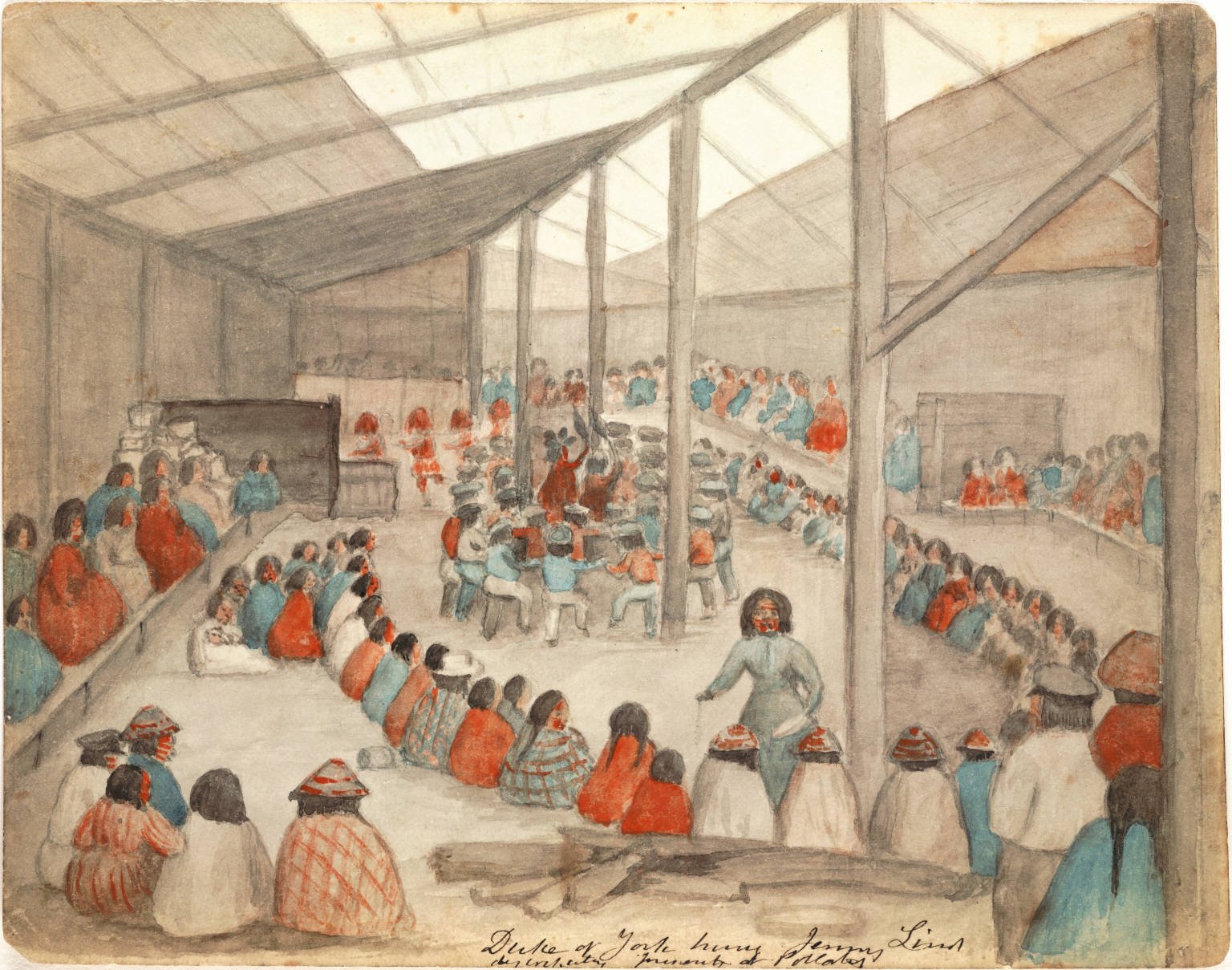
Key decisions around the AI lifecycle are made by those in economic and political power. These decisions are often crafted in ways that serve this power, allowing its accumulation rather than its redistribution. As a result, the chasm between the powerful and the disenfranchised widens, and the structural reality this creates is one where the harms are socialized and benefits are privatized. Potlatch, an Indigenous practice of the Kwakwaka’wakw, Haida, Tlingit, Nuu-chah-nulth, Coast Salish, and other communities, helps us shift this approach to a more inclusive approach.
Understanding Potlatch
The term “Potlatch” comes from the Chinook Jargon word “patshatl,” which means “to give,” is the primary governmental institution, legislative body, and economic system of the peoples of the Pacific Northwest Coast. Practiced by the Kwakwaka'wakw, Haida, Tlingit, Nuu-chah-nulth, Gitxsan, and many other nations, potlatch is a ceremony that lasts several days or weeks in which the host family distributes wealth (in the form of blankets, food, canoes, coppers) to guests, affirming or transferring hereditary titles, validating rights to territories and resources, memorializing the dead, marking marriages and births, and resolving disputes. Each gift creates an obligation, where the recipient must host their own potlatch in future, returning gifts of equal or greater value, sustaining a permanent cycle of redistribution and social interaction.
Potlatch subverts capitalism's founding assumption. In capitalist logic, status accrues to those who accumulate the most. In potlatch logic, status accrues to those who give the most away. Recent economic scholarship has modeled the potlatch as a decentralized exchange system in which social memory, carried in ceremony, song, dance, and storytelling, sustains gift-giving networks that increase wealth and social welfare.
However, the settler colonial government has dismissed potlatch as wasteful, irrational, and an impediment to civilization, and banned it precisely because it embodied a competing economic logic, in which wealth circulates rather than concentrates, and in which the purpose of accumulating resources is to redistribute them. In 1884, the Canadian government amended the Indian Act to outlaw potlatch. The ban remained on the books until 1951. In those years when the ban was in place, Indigenous families of the Pacific Northwest who held or attended potlatches faced arrest, imprisonment, and the confiscation of ceremonial objects now scattered in museum collections around the world. One of the most notorious raids occurred in December 1921 at the village of 'Mimkwamlis, when Chief Dan Cranmer held a large potlatch on Village Island. During the raids, 45 people were arrested, and 20 went to Oakalla Prison in Burnaby, British Columbia. The government demanded that communities surrender their ceremonial regalia, namely masks, coppers, and button blankets, as a condition for the release of those imprisoned. These objects are still being repatriated. The colonial state knew that the potlatch was not merely a feast. It was a governance system that was incompatible with the accumulation logic the colonial project required.
What Potlatch unsettles in AI governance
Potlatch presents AI governance with its most direct challenge to the current distribution of AI's benefits. The AI economy is a potlatch run backwards: Those who hold the most, such as the largest models, the most data, the greatest compute gain the most status, attract the most capital, and concentrate power further. The communities whose data, labor, and land underpin AI development receive the least. There is no obligation of return encoded in the system; no ceremony that makes redistribution a condition of legitimate authority.
A potlatch logic applied to AI governance would demand that the accumulation of AI capability obligates redistribution. The larger your model, the more you owe to the communities whose knowledge trained it. The greater your compute infrastructure, the more you are obligated to share its capacity with those who cannot afford it. The concentration of AI benefit is itself a mark of failed governance, not of success. This is not a minor tweak to existing frameworks. It requires reconceiving the relationship between power and obligation at the heart of AI development, not as a question of corporate social responsibility, but as a constitutional condition of legitimate operation.
Potlatch also models how governance can be carried in ceremony and in the social fabric of a community, not only in formal institutions. The potlatch was not merely a redistribution mechanism, but rather, it was a living constitutional practice in which rights, relationships, and obligations were publicly witnessed, affirmed, and remembered. The ban on Potlatch was understood by colonial authorities as essential to the destruction of Indigenous governance, because without the ceremony, the governance it sustained could not function. For AI governance, this is a reminder that the texture of community practice, namely how communities regularly come together to affirm their obligations to each other, is itself a form of governance, and that purely procedural or technical frameworks cannot substitute for it.
References
Barnett, H. G. (1938). The nature of the potlatch. American Anthropologist, 40(3), 349-358.
Boas, F. (1897). The Social Organization and Secret Societies of the Kwakiutl Indians. Report of the U.S. National Museum.
Canadian History Ehx. (2026). The Potlatch Ban. https://canadaehx.substack.com/p/the-potlatch-ban
Codere, H. (1950). Fighting with Property: A Study of Kwakiutl Potlatching and Warfare, 1792–1930. University of Washington Press.
Native American Tribes. (2025). The Potlatch Ceremony: A Symphony of Giving, Power, and Resilience. https://nativeamericantribes.info/the-potlatch-ceremony-a-symphony-of-giving-power-and-resilience/
Pender, C., & Gross, T. (2025). The Potlatch as Memory: Ceremony and Gift-Giving along the Pacific Northwest. SSRN Working Paper. https://ssrn.com/abstract=5297516
